
Last updated: 1 September 2026
Written by Adelaide Stewart-Jones, accredited dog trainer (IMDT, UK Dog Behaviour and Training Charter) and IAABC member. Founder of The Confident K9 in Kidderminster.
Crate training is one of the kindest, most useful skills you can teach a new puppy. Done well, your puppy gets a safe den they love retreating to, and you get a sleep-trained, toilet-trained, separation-confident dog. Done badly, it becomes a nightly battle that puts everyone off the idea entirely.
This guide walks you through how to crate train a puppy properly, from picking the right crate to surviving the first night to weaning off the crate later on.
🐾 Stuck on crate training? Crate training is one of the most common topics we cover in 1:1 sessions across Kidderminster and Worcestershire. We can troubleshoot what is going wrong in 60 minutes. Book your free 20-minute call
Is crate training cruel?
Short answer: no. Done properly, it is the opposite. Dogs are den animals. Wild dogs and wolves seek out small, enclosed spaces to rest and feel safe. A crate gives your puppy a personal den they can retreat to when they are tired, overstimulated, or just want some peace.
The reason crates get a bad reputation is owners using them wrongly: leaving puppies in them too long, using them as punishment, or shutting puppies in before they have built a positive association.
When done properly, most adult dogs will choose to nap in their crate even when the door is open, for the rest of their life.
What size crate do I need?
Your puppy needs to be able to stand up, turn around, and lie down stretched out. They do NOT need to be able to play or pace — that defeats the point.
The best approach is to buy a crate sized for your puppy’s expected adult size, and use the divider that comes with most decent crates to make it smaller for now. Expand it as they grow.
A rough guide:
| Adult dog size | Crate size |
| Small (Cavalier, Cocker) | 30” / 76cm |
| Medium (Springer, Border Collie) | 36” / 91cm |
| Large (Labrador, Boxer) | 42” / 107cm |
| Extra large (Rottweiler, GSD) | 48” / 122cm |
Setting up the crate
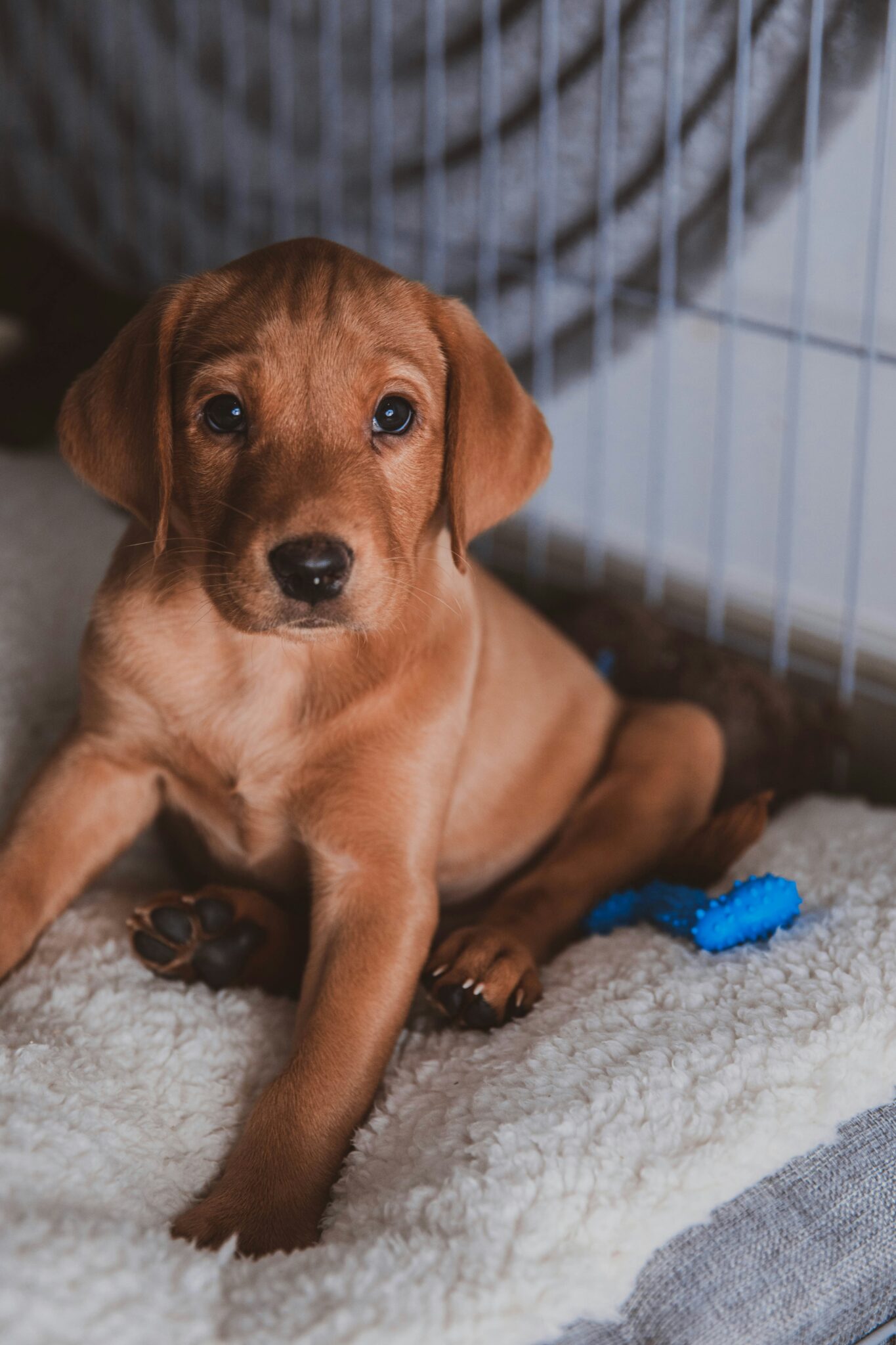
- Place it somewhere quiet but not isolated. Most owners put it in the kitchen or living room.
- Add comfortable, washable bedding. An old fleece or veterinary bedding works well.
- Put a worn item of your clothing inside. Your scent is reassuring.
- Do not position it in direct sunlight or next to a radiator.
- Cover the sides and back with a blanket to make it feel more den-like.
Step-by-step: building a positive association
This process should take several days. Do not rush it.
Day 1 to 2: introduce the crate Leave the door open. Drop treats near the entrance, then just inside. Let your puppy investigate in their own time. Do not push them in. Feed meals near the crate.
Day 3 to 4: meals inside Begin feeding meals just inside the door, then progress to the back of the crate. Close the door briefly while they eat, then open immediately. Build the closed-door time by a few seconds each meal.
Day 5 to 7: short sessions with the door closed With your puppy in the crate, close the door and sit nearby for a few minutes. Open before they get restless. Gradually extend the time. Begin leaving the room briefly.
Week 2: building duration Your puppy should now be comfortable with 20 to 30 minutes in the crate. Begin using it for nap times during the day. A puppy that has been played with and has had the chance to toilet is ready for a crate rest.
Overnight crate training
Put the crate in your bedroom for the first few weeks. Your puppy needs to hear and smell you. This is not a permanent arrangement — it is a transition.
Expect your puppy to wake once or twice in the night for the first couple of weeks. Take them outside quietly, let them toilet, then straight back to the crate. No play, no fuss.
Most puppies can sleep through the night by 12 to 16 weeks, provided they have been toileted just before bed and the crate is the right size.
Common crate training problems
Puppy crying in the crate Do not rush in the moment they make a sound. Wait for a pause, then let them out. Going in while they are crying teaches them that crying works. However, if your puppy is distressed rather than grumbling, go back a step in the process — you have moved too fast.
Puppy refusing to go in Go back to basics. More time on positive association, higher value treats, feed more meals inside. Never push or lure a reluctant puppy inside with your body.
Puppy toileting in the crate Check the crate is not too big. If there is room to toilet at one end and sleep at the other, they will. Also check you are not leaving them in longer than they can hold it. Young puppies cannot hold their bladder for more than two hours during the day.
When should I stop using the crate?
Most dogs can be left out of the crate during the day from around 12 months, depending on chewing reliability and toilet training. Many dogs continue to sleep in their crate with the door open for life because they love it. There is no need to rush the transition.






Comments are closed