Last updated: 5 October 2026
By Adelaide Stewart-Jones, accredited dog trainer (IMDT, UK Dog Behaviour and Training Charter) and IAABC member. Founder of The Confident K9 in Kidderminster.
Muddy paw prints on your work trousers. A visiting grandparent knocked off balance. A child in tears after an over-excited greeting. Jumping up is one of the most common reasons owners contact me for dog training in Kidderminster, and it is also one of the most misunderstood.
Most owners have already tried the usual advice: turning their back, saying “off”, pushing the dog down, or lifting a knee. Most have found that it either does not work or works for a few days before the jumping returns. This guide explains why, and sets out a practical, force-free plan for how to stop a dog jumping up for good.
🐾 Want hands-on help with jumping up? Our dog training packages cover greetings, manners and impulse control with in-person sessions around Kidderminster and online sessions UK-wide.
Why dogs jump up
Jumping up is not bad behaviour. It is normal dog behaviour in the wrong context.
Puppies greet adult dogs by licking around their mouths, and our faces are a long way up. Jumping is how a dog gets closer to the part of us that communicates the most. It is a social, often appeasing behaviour, and for many dogs it is driven by genuine excitement at seeing someone they like.
It is also behaviour that pays. Even when we think we are discouraging it, jumping is often rewarded with eye contact, touch, voice and movement. Pushing a dog down is touch. Saying “off” is attention. For a sociable dog, any reaction can be better than none.
Finally, jumping is closely linked to arousal. A dog who is already over-excited, stressed or tired has far less ability to keep four paws on the floor. That is why jumping often gets worse when visitors arrive, at the end of a busy day, or after a walk full of excitement.
Why the usual advice often fails
Turning your back can work in theory, because it removes attention. In practice, it rarely works on its own. Dogs often jump on your back instead, visitors do not do it consistently, and nothing tells the dog what they should be doing instead.
Kneeing, pushing or shouting carries real risks. Research has repeatedly linked confrontational and aversive methods with increased stress and a higher risk of aggressive responses. A 2009 study found that confrontational techniques frequently provoked aggressive responses in dogs, and a 2020 study found that dogs trained with aversive methods showed more stress-related behaviours and a more pessimistic outlook. For a behaviour driven by social motivation, adding fear or pain into greetings is the last thing we want.
Inconsistency is the biggest reason jumping persists. If one family member enjoys the jumping and everyone else discourages it, the dog learns that jumping sometimes pays off, and behaviour that sometimes pays off is extremely persistent. We explain why dogs behave differently with different people in our dog behaviour Q&A.
How to stop a dog jumping up: the four-part plan
Part 1: Manage the moments that matter
Every time your dog jumps and gets a reaction, the behaviour gets stronger. While you are training, prevent rehearsal as much as possible. Pop your dog behind a baby gate or in another room before opening the front door. Keep a lead or house line on them when visitors arrive. Ask guests to wait until your dog is calm before saying hello. Management is not cheating. It protects your training.
Part 2: Teach what you want instead
Dogs cannot learn “do not jump” in a vacuum. They learn far faster when we teach them something else to do. The most useful alternatives are:
Four on the floor. Simply reward your dog every time all four paws are on the ground near a person. Drop a high-value treat such as cooked chicken, cheese or hot dog sausage at their feet, so their nose is pointing down rather than up.
A hand target. Teach your dog to touch their nose to your palm. This gives them a clear, social way to say hello and can be offered at a height that keeps them low.
Go to your mat. A mat or bed a little way from the front door gives your dog a job when the doorbell rings.
Sit to greet. A classic for good reason, but only once the dog can do it easily in calm situations first.
Part 3: Bring the greeting down to their level
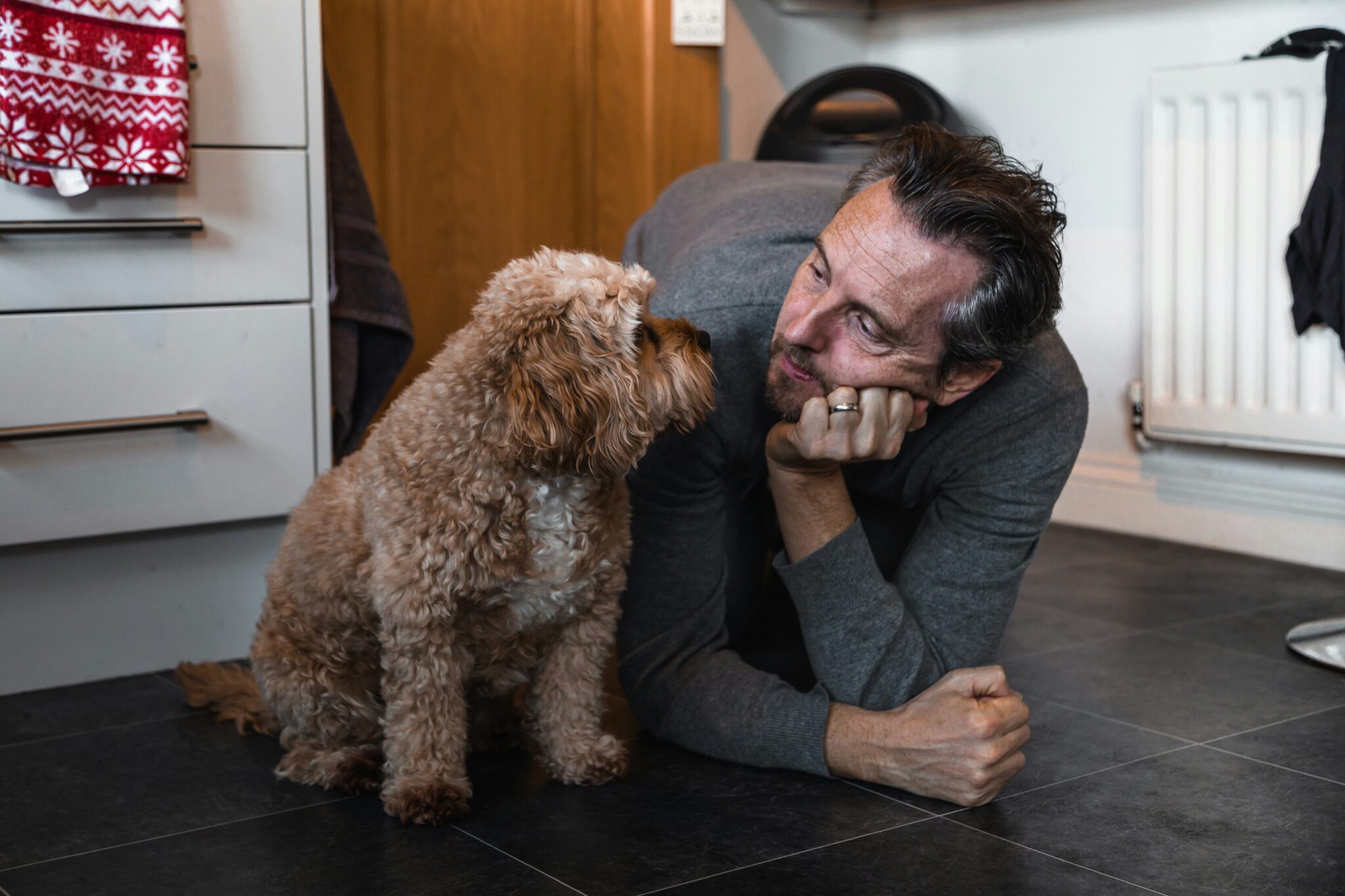
This is one of my favourite techniques, and it is rarely mentioned. When you come home, or when a visitor arrives, scatter a small handful of treats on the floor as you walk in. Your dog’s first instinct becomes sniffing the floor rather than launching at faces. Sniffing also helps to lower arousal. Once they have found the treats and are calmer, greet them calmly and at their level. Over time, arriving people come to predict “look down” rather than “jump up”.
Part 4: Lower the excitement
If your dog jumps mainly when they are over-aroused, training the greeting alone will only get you so far. Keep homecomings low-key. Build calm settling into your daily routine. Watch out for trigger stacking: several exciting events in one day can push a dog over the edge, even if they could cope with each one on its own. Dogs who jump at people while out walking, particularly with lunging or barking, may be showing reactivity rather than simple over-excitement, which we cover in our post on reactive dog training in Kidderminster.
Puppies and jumping up
Puppies jump because it works and because it is natural. The best time to teach a polite greeting is from the very first week, before jumping becomes a habit. Our week-by-week puppy training schedule shows where greetings fit into early training, and puppies who jump and mouth at the same time may also benefit from our guide on how to stop puppy biting.
For young, large breed dogs, reducing repeated jumping is worth doing for physical reasons too, as growing joints are not designed for constant impact on hard floors.
Jumping up at children
Jumping at children deserves special care. Children are lower down, move quickly and squeal, all of which can increase a dog’s excitement. A jumping dog can easily knock over or scratch a child. Always supervise interactions, use management such as baby gates, and teach children to stand still and calm rather than run. If jumping at children comes with mouthing, stiffness or growling, please seek professional advice, and see our guide to resource guarding in dogs and children for related warning signs.
How long does it take?
With consistent management and training, most dogs show clear improvement within a few weeks. The most common reason for slow progress is that someone in the household, or a regular visitor, is still rewarding the jumping. Expect a brief worsening when you first stop rewarding it. This is known as an extinction burst, and it is a sign the training is working, not failing.
If you would like support tailored to your dog, our dog training services in Kidderminster and across Worcestershire can help. If you are looking for a qualified trainer elsewhere, the Animal Behaviour and Training Council keeps a register of accredited practitioners.
View dog training packages and book online
FAQ
Why does my dog jump up at people?
Dogs jump up to get closer to our faces, which is natural greeting behaviour. It is usually driven by excitement and social motivation, and it persists because it is rewarded with attention, touch or voice, even when we are trying to discourage it.
Should I knee my dog when they jump up?
No. Kneeing, pushing or shouting can cause pain or fear and has been linked to increased stress and aggression. It also does not teach your dog what to do instead. Reward-based methods are kinder and more effective.
Does turning your back stop a dog jumping up?
It can help as part of a plan, but rarely works on its own. Many dogs jump on your back instead, and it does not show the dog what you want. Combine it with teaching an alternative such as four on the floor or a hand target.
How do I stop my dog jumping up at visitors?
Manage the situation with a lead, baby gate or separate room while you train. Teach your dog to go to a mat when the doorbell rings, scatter treats on the floor as visitors arrive, and ask guests to greet only once your dog is calm.
At what age do dogs stop jumping up?
Dogs do not simply grow out of jumping up. If it is rewarded, it can continue for life. The earlier you start teaching an alternative greeting, the easier it is, but adult dogs can absolutely learn new habits.
Why is my dog’s jumping getting worse?
If you have recently stopped rewarding jumping, a temporary increase is normal and is called an extinction burst. Jumping can also get worse with increased excitement, stress or tiredness, so look at your dog’s overall routine and arousal levels.
How do I stop my dog jumping up on walks?
Keep your dog on a lead around people while training, reward four paws on the ground, and increase distance from passers-by. If jumping comes with barking or lunging, your dog may be reactive and would benefit from a different approach.
Is jumping up a sign of dominance?
No. The idea that dogs jump to assert dominance is outdated and not supported by current behaviour science. Jumping is a normal greeting behaviour driven by excitement and social motivation.
Can you help with jumping up online?
Yes. Jumping up responds very well to online training sessions, as we can watch real greetings at your front door via video and coach you in the moment. We also offer in-person sessions around Kidderminster.






Comments are closed